
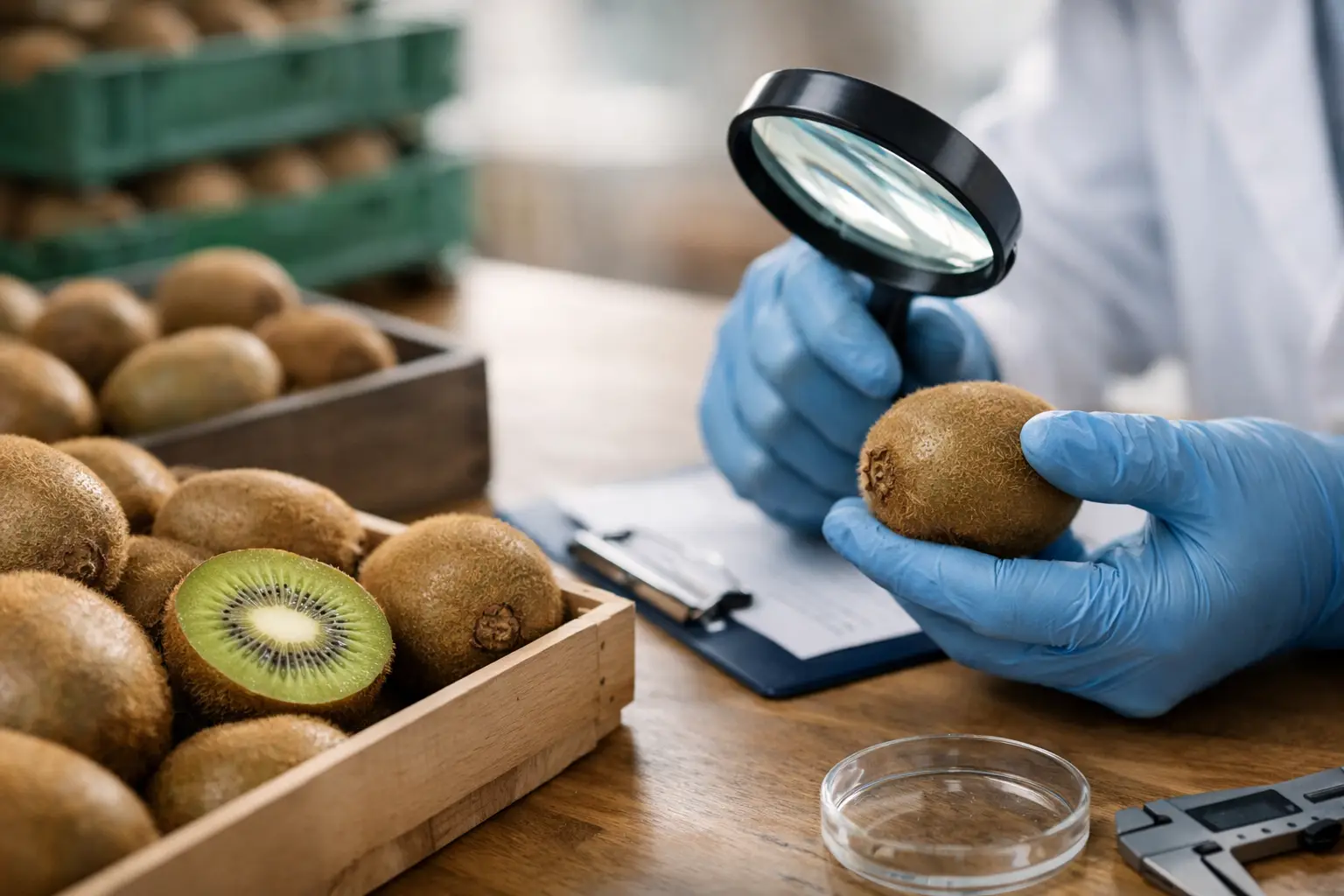
A kiwi shipment can look excellent at loading and still fail commercially at destination. The difference usually comes down to whether kiwi export quality standards were treated as a checklist or as a full operating discipline across harvest, sorting, packing, storage, and transport. For professional buyers, that distinction affects shrink, shelf life, claims, and retail confidence.
In export trade, quality is not judged by appearance alone. Uniformity within the lot, dry matter and Brix development, firmness management, skin condition, labeling accuracy, and traceability all influence whether a consignment performs as promised. When one of these variables is weak, even fruit with strong visual appeal can create problems after arrival.
Why kiwi export quality standards carry commercial weight
For importers, distributors, and retail programs, kiwi quality standards are not simply technical specifications. They are a risk-control framework. The goal is to receive fruit that arrives in marketable condition, ripens predictably, and holds well enough to support downstream sales.
This is especially relevant in kiwi, where timing matters. Harvest too early and the fruit may struggle to develop eating quality. Harvest too late and storage potential can narrow. Pack fruit with poor size consistency and the buyer faces merchandising issues. Allow weak temperature control and firmness can decline unevenly across the lot. Every stage has a direct commercial effect.
That is why serious export programs work backward from destination requirements. A shipment intended for nearby markets may tolerate one maturity profile and transit plan, while long-haul programs require tighter control on harvest maturity, pre-cooling, carton ventilation, and cold chain discipline. Standards matter, but so does matching those standards to the route, customer specification, and sales window.
The core parameters behind kiwi export quality standards
At a practical level, most kiwi export quality standards revolve around a few decisive criteria. The first is maturity at harvest. Export fruit must be physiologically ready, with sugar development and dry matter at levels that support proper ripening after transit. If the maturity baseline is wrong, later interventions cannot fully correct it.
Size is another key parameter. Professional buyers expect calibrated fruit packed to agreed count ranges or weight classes, with minimal deviation inside each carton and across the shipment. Size consistency affects retail presentation, pricing, and customer satisfaction. Mixed sizes in the same lot create friction immediately.
External appearance also remains central. Skin should be clean, sound, and free from significant scars, bruising, cuts, decay, deformation, or sunburn that would reduce commercial value. Minor cosmetic variation may be acceptable depending on the market and grade, but tolerance limits must be clearly understood before shipment.
Firmness is equally important, especially for distant destinations. Fruit that is too hard may delay category performance at retail, while fruit that is too soft can shorten shelf life and increase waste. The correct firmness profile depends on transit time, storage plan, and customer handling capability.
Then there is internal quality. Brix, flesh condition, absence of internal breakdown, and overall eating quality influence repeat business more than appearance alone. A lot can pass visual inspection and still disappoint the end market if internal condition is inconsistent.
Grade, tolerances, and uniformity across the lot
One of the most common misunderstandings in kiwi trade is assuming that average quality is enough. It is not. Buyers do not sell averages. They sell cartons, trays, and consumer units that must perform consistently. That is why grade tolerances and lot uniformity are so important.
A strong export lot is not simply one with many good fruits. It is one with tightly controlled variation. If defects are concentrated in some cartons, claims become likely even when the broader shipment looks acceptable on paper. The same applies to differences in firmness, color, or size between pallets.
Professional packing operations therefore focus on sorting precision as much as top-grade appearance. The objective is to align every packed unit with the agreed commercial specification. This includes count accuracy, grade integrity, visual consistency, and correct pallet build. For large retail programs, this level of discipline is often more valuable than chasing the absolute highest visual standard in isolated cartons.
Harvest timing shapes export performance
The most advanced packing line cannot compensate for poor harvest decisions. Kiwi destined for export must be harvested at the right maturity window, based on objective measurement rather than visual estimation alone. Brix and dry matter benchmarks are commonly used because they give a more reliable view of ripening potential.
This is where supply chain alignment becomes critical. Grower selection, orchard monitoring, and harvest coordination all influence whether the exported product can meet destination expectations. Fruit from different orchards may not perform identically, even when grown in the same region. Soil conditions, crop load, irrigation strategy, and picking date all leave a quality signature on the final lot.
For exporters serving demanding B2B customers, orchard-level discipline is not optional. It is the foundation of consistency. The strongest programs build quality before the fruit reaches the packing facility.
Packing, traceability, and cold chain control
Packing is where commercial promises become measurable. Cartons must protect the fruit, preserve ventilation, support stacking strength, and match customer presentation requirements. Labeling must be correct and complete, including origin, lot coding, size reference, and any required pack information. Errors here create avoidable risk.
Traceability is now a basic requirement for credible export business. Buyers want to know where the fruit came from, how it was packed, and how each lot can be identified if an issue appears later. Good traceability protects both sides of the transaction. It supports food safety, speeds claim investigation, and reinforces confidence in long-term supply relationships.
Cold chain management is just as decisive. Pre-cooling, stable storage temperatures, humidity control, and clean loading practices all protect firmness and reduce physiological stress. In kiwi exports, weak cold chain discipline often shows up later as uneven ripening, condensation damage, or reduced shelf life. By the time those issues appear, the commercial damage is already done.
Market requirements are not identical
One specification does not fit every destination. Some markets prioritize larger size and premium appearance. Others focus more on price-positioned consistency and reliable arrival condition. Retail chains may require tighter tolerances than wholesale markets, while foodservice buyers may emphasize functionality over cosmetic perfection.
This is where experience matters. A capable exporter understands that kiwi export quality standards must be interpreted through the lens of the customer program. Pushing an unnecessarily high spec can raise cost without adding real value. Accepting a loose spec can undermine brand perception and increase downstream losses. The right balance depends on the market.
For that reason, the best commercial relationships are built on clear pre-shipment alignment. Grade definition, size range, firmness target, packaging format, pallet pattern, and transit expectations should be agreed before loading. Ambiguity benefits no one.
What serious buyers should verify before booking
Before confirming a kiwi program, buyers should look beyond headline claims about premium fruit. The more useful questions concern process control. How are growers selected and monitored. What maturity criteria are used at harvest. How is sorting calibrated. What tolerances apply. How is traceability maintained. How is temperature managed from packing to dispatch.
These questions reveal whether quality is systematic or opportunistic. In export business, consistency usually comes from process, not from occasional strong crops.
This is also where a structured supplier has an advantage. Companies with control from field selection through packing and dispatch are better positioned to protect uniformity, freshness, and documentation accuracy. For B2B buyers managing retail or wholesale commitments, that translates into lower operational uncertainty. Within that framework, ELYSIAN FRUIT reflects the kind of export model international buyers increasingly value - selected production, strict sorting, traceability, and dependable handling built around premium Greek fruit.
Quality standards protect long-term trade
The real value of quality standards is not that they create paperwork. It is that they create predictability. In kiwi exports, predictability is what supports repeat orders, stable retail programs, and fewer disputes across the chain.
There is always a commercial tension between cost, appearance, storage life, and market timing. No exporter can remove every variable, and no buyer should expect zero natural variation in fresh produce. But disciplined standards sharply reduce avoidable problems. They create a common language between grower, exporter, importer, and retailer.
For buyers who build their reputation on reliable fruit, kiwi quality should be assessed as a supply system, not just as a product sample. When harvest maturity, sorting accuracy, traceability, and cold chain control are aligned, the shipment has a far better chance of arriving not only acceptable, but commercially successful. That is where strong business begins.







Comments