
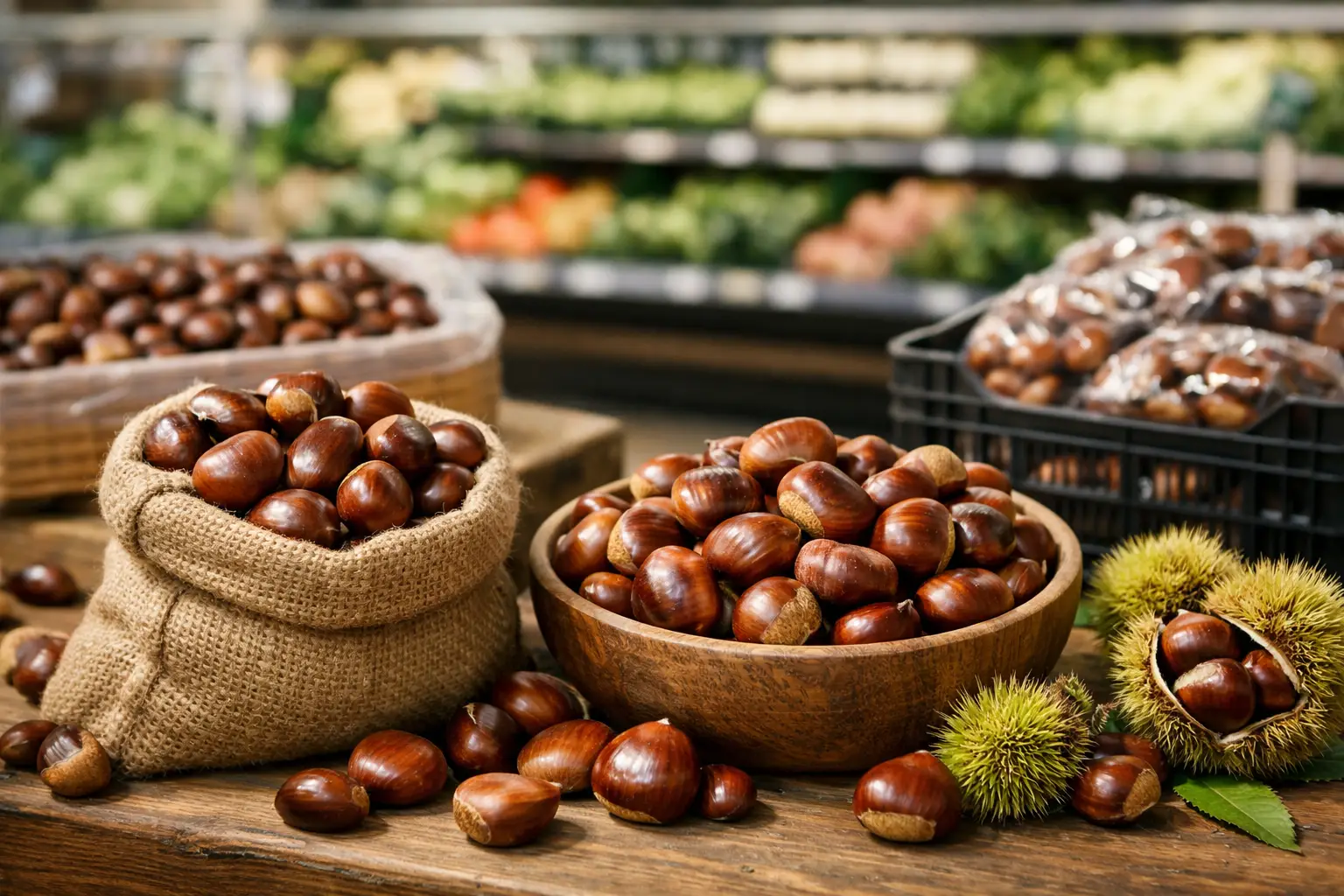
Retail chestnuts fail or succeed long before they reach the shelf. For supermarket buyers, the real issue is not simply sourcing product. It is choosing a chestnut supplier for supermarkets that can protect quality, maintain consistency across shipments, and support retail performance with disciplined handling from origin to delivery.
Chestnuts are a sensitive category. They are seasonal, highly perishable compared with many other hard-shell products, and heavily influenced by harvest timing, sorting accuracy, moisture balance, and storage conditions. For chains that need dependable programs rather than opportunistic purchases, supplier selection becomes a commercial decision with direct impact on shrink, customer satisfaction, and repeat sales.
What supermarkets actually need from a chestnut supplier
In wholesale trade, price gets attention first, but performance is what protects margin. A supermarket program needs chestnuts that arrive with stable quality, good visual appearance, and the right eating characteristics for the market. That means uniform grading, controlled packing, and lot-by-lot traceability.
A capable chestnut supplier for supermarkets understands that retail requirements extend beyond harvesting and shipping. Buyers need predictable sizing, low defect rates, and packaging that can move efficiently through distribution centers and stores. They also need clear communication on crop conditions, availability windows, and expected shelf behavior.
This is where many supply relationships separate. A general trader may secure volume, but volume alone does not solve issues such as mixed calibers, inconsistent skin quality, internal defects, or weak coordination during peak demand periods. Supermarket buyers usually need a partner who can manage the category with discipline, not just broker product.
Why origin and production control matter
Chestnuts are not interchangeable. Origin influences flavor profile, size potential, harvest timing, and post-harvest stability. Just as important, the production model behind the product affects consistency. When a supplier has a close relationship with growers and quality control teams on the ground, there is far better control over harvest maturity, selection standards, and packing outcomes.
For retail chains, this matters because inconsistency creates operational cost. If one load performs well and the next one shows excessive defects, the result is not only waste. It also affects store confidence in the category and weakens promotional planning.
Greek chestnuts are increasingly valued in international markets because they combine strong natural quality with a supply base capable of serving demanding trade channels. Yet origin alone is not enough. The supplier must organize the chain correctly, from field selection to final dispatch, so that premium quality remains measurable and repeatable.
Quality control is not a marketing claim
Serious supermarket procurement teams look past broad promises. They want to know how quality is verified and where control points exist. A reliable supplier should be able to define the process clearly: producer selection, harvest monitoring, intake inspection, grading, sorting, packaging, storage, and shipment release.
In chestnuts, quality control has to cover both external and internal characteristics. Attractive appearance is important for retail presentation, but internal condition is what determines consumer experience. If the product looks sound but performs poorly in the kitchen, the category loses trust fast.
That is why disciplined sorting and inspection are essential. Premium retail supply depends on reducing variability at the lot level. The aim is not perfection in theory. The aim is commercial reliability in practice.
The role of packaging in supermarket performance
Packaging is often underestimated when buyers evaluate a chestnut supplier for supermarkets. In reality, packaging affects protection, ventilation, presentation, handling efficiency, and shelf life. The right format depends on the target market, store model, and distribution route.
For some programs, bulk supply into the retailer's own packing operation makes sense. For others, ready retail packs are more efficient and reduce handling risk. Neither option is universally better. It depends on labor structure, replenishment rhythm, and how the chain manages fresh produce turnover.
What matters most is that packaging supports product integrity throughout the route. Chestnuts should not be treated as a generic dry product. Their freshness profile requires attention to ventilation, temperature management, and packing discipline. Poor packaging decisions can quickly erase the value created at production level.
Traceability reduces commercial risk
For international retail, traceability is no longer optional. It is a basic expectation. Supermarket buyers need visibility from source to shipment, especially in categories where quality can vary by orchard, harvest date, and handling batch.
A supplier with strong traceability systems gives buyers confidence in more than food safety. It also supports claims management, stock monitoring, and more accurate evaluation of supplier performance over time. When issues arise, and in fresh produce they occasionally do, traceability allows fast, precise action rather than broad disruption.
For chestnuts, this is especially important because retail windows are compressed and demand can intensify around seasonal peaks. Clear lot identification and documented handling procedures help buyers protect continuity while maintaining compliance with internal standards and international market expectations.
Consistency beats spot-market opportunity
There are moments when spot buying appears attractive. A sharp price can look compelling, especially in a competitive retail environment. But chestnuts are a category where inconsistency often costs more than the invoice suggests.
Supermarkets typically perform better with structured supply programs than with fragmented purchasing. Consistent sizing, agreed specifications, dependable delivery schedules, and ongoing communication make it easier to plan promotions, allocate inventory, and maintain shelf standards. A lower-priced shipment that underperforms can create hidden costs through shrink, complaints, markdowns, and emergency replacement purchases.
This is why long-term supplier relationships matter. They create room for planning, better crop visibility, and more stable execution. For buyers managing multiple stores or cross-border distribution, that stability is often worth more than a temporary price advantage.
What to ask a chestnut supplier for supermarkets
A professional buying conversation should go beyond availability and quote. The stronger questions are operational. How is grower selection managed? What grading standards apply by lot? How are defects monitored? What packaging formats are available? What are the storage and transport conditions? How is traceability documented? What lead times are realistic during peak season?
It is also useful to ask how the supplier handles variance. No agricultural product is fully identical every week. What matters is whether the supplier communicates early, adjusts responsibly, and protects the buyer from avoidable surprises.
The best partners are transparent. They do not overpromise on crop volume or quality profile. They explain what is stable, what may shift seasonally, and how they manage those changes within agreed commercial parameters.
The value of an integrated supply model
For supermarket supply, an integrated model offers a clear advantage. When one company oversees or closely manages production, selection, packing, and dispatch, there are fewer gaps in accountability. That usually translates into stronger quality discipline and more dependable service.
This is particularly relevant in export-oriented fresh produce. International buyers need suppliers who understand retail standards, documentation requirements, transport coordination, and the commercial consequences of delay. A supplier working only at trading level may struggle to control the variables that matter most.
Companies such as ELYSIAN FRUIT are positioned for this kind of work because they operate with a clear wholesale and international market focus, combining selected production, strict sorting, standardized packing, traceability, and safe transport. For supermarket buyers, that kind of structure supports confidence in both product and execution.
A premium chestnut program depends on discipline
Chestnuts can be a profitable and reputation-building seasonal category for supermarkets, but only when the supply chain is managed with precision. The category rewards buyers who prioritize quality systems, consistency, and professional coordination over short-term sourcing convenience.
The right chestnut supplier for supermarkets brings more than product availability. They bring control at origin, premium quality standards, traceability, reliable packing, and a delivery model that respects the commercial realities of retail. That is what turns a seasonal item into a dependable program.
For buyers building long-term supermarket assortments, the better question is not who can ship chestnuts this week. It is who can support the category with the same consistency every week it matters.



Comments