
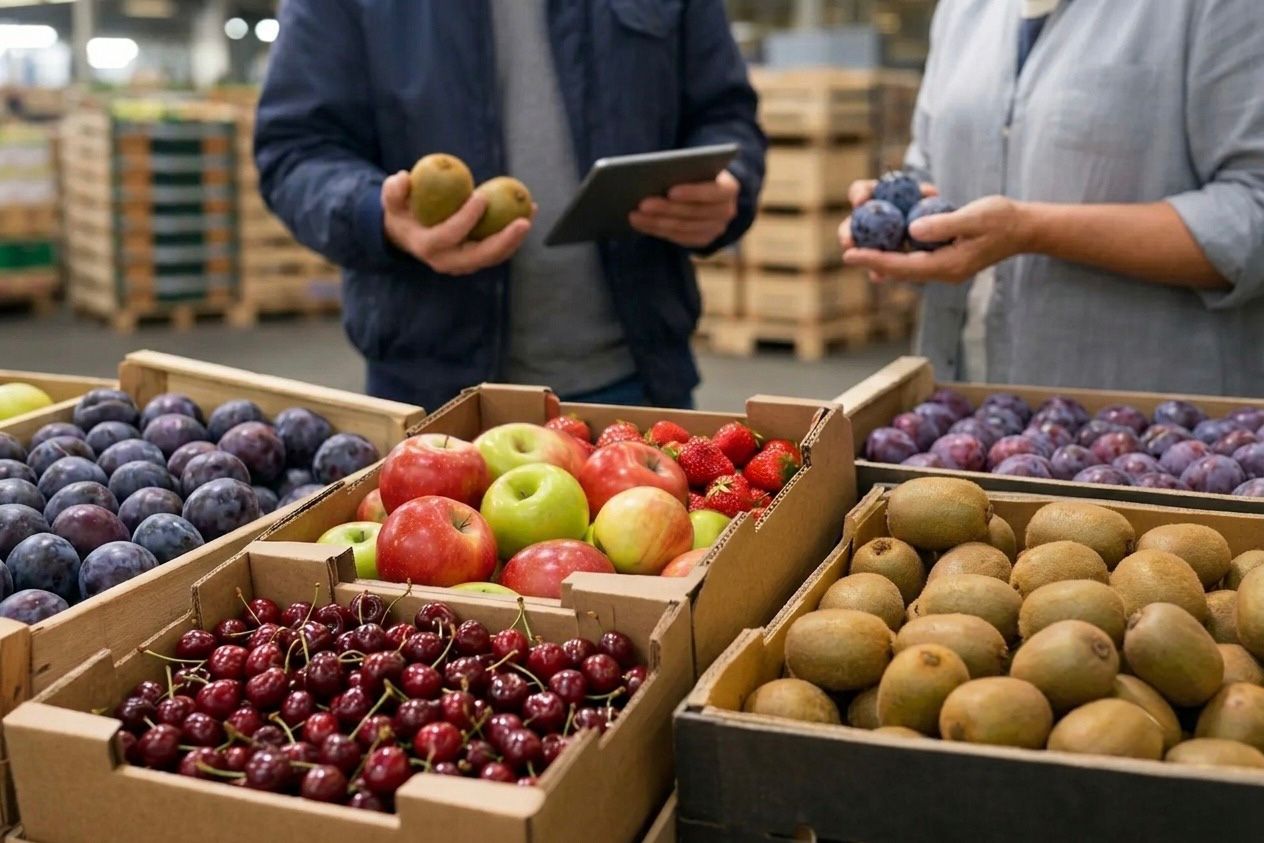
One late shipment at peak season can erase the margin on an otherwise strong fruit program. For importers, distributors, and retail buyers, that is why a guide to wholesale fruit sourcing has to start with risk control, not price alone. In fresh fruit, the real buying decision sits where origin, grading, packing, timing, and logistics meet.
Wholesale fruit sourcing looks simple from a distance. A buyer needs volume, a supplier offers fruit, and the season moves forward. In practice, the difference between a workable program and an expensive problem usually comes down to supplier structure, product consistency, and execution under pressure. Premium fruit is not defined only by appearance. It is defined by repeatability.
What a guide to wholesale fruit sourcing should actually help you evaluate
Professional buyers rarely struggle to find fruit. They struggle to secure fruit that arrives as agreed, matches the approved specification, and performs commercially after delivery. That is a different standard.
A reliable sourcing strategy should help answer a few hard questions early. Can the supplier maintain consistent grading across shipments? Is there traceability at lot level? Are packing formats aligned with the destination market? Can the operation support both quality control and export handling without creating delays? If those points remain vague, the commercial risk stays high, even when the offer price looks competitive.
This is especially true for highly perishable categories such as cherries, apricots, strawberries, and peaches, where every hour in handling matters. It also applies to products with longer commercial windows, such as kiwifruit, apples, chestnuts, or oranges, where storage, sorting discipline, and packing accuracy still determine downstream performance.
Start with origin, but do not stop there
Origin matters because it shapes seasonality, flavor profile, availability windows, and market positioning. Greek fruit, for example, carries strong value in many international markets because it combines Mediterranean growing conditions with access to European transport routes. But origin alone is not a sourcing strategy.
The stronger question is how closely your supplier is connected to production. A company that works directly from the field, or through selected growers with established quality protocols, can usually give clearer answers on maturity, harvesting timing, expected volumes, and lot consistency. A purely opportunistic trader may still offer product, but often with less control over variability between shipments.
That distinction affects more than quality. It affects planning. Buyers who manage wholesale channels or retail promotions need realistic information on harvest progression, sizing profiles, and available packing options. If the supplier cannot provide that visibility, forecasting becomes guesswork.
Supplier selection is about control points
A serious wholesale partner should be evaluated by the control points built into the operation. This includes grower selection, field monitoring, intake inspection, sorting, packing, cold chain management, and shipment preparation. Each stage protects commercial value.
At supplier level, ask how fruit is selected before it reaches the packing line. Ask what happens when a lot falls outside target specification. Ask how defects are monitored and documented. Ask who approves export lots and whether the same quality language is used by sales, operations, and quality control teams. Misalignment between those functions is one of the most common causes of claim disputes.
This is where premium positioning becomes credible or empty. Premium quality is not a label added after harvest. It is the result of disciplined choices at every stage, from orchard management to final pallet configuration.
The guide to wholesale fruit sourcing for quality-focused buyers
For quality-focused buyers, specifications need to move beyond broad terms like good fruit or export quality. Those phrases are too loose for commercial use. The sourcing process should define measurable expectations: size range, color level, firmness, sugar where relevant, defect tolerance, packaging type, label requirements, pallet pattern, and temperature conditions.
The more precise the specification, the lower the risk of conflict later. That does not mean every shipment will be identical. Fresh produce is an agricultural product, and natural variation exists. But professional sourcing accepts that reality and manages it through agreed tolerances.
There is also a practical balance to maintain. An extremely narrow specification can reduce flexibility and push costs higher, especially in tight market periods. A broader specification may improve supply continuity, but it can weaken shelf performance or customer satisfaction. The right choice depends on your sales channel, claim sensitivity, and margin model.
Timing is a sourcing decision, not just a logistics detail
In wholesale fruit, timing starts in the orchard. Harvesting too early may protect firmness but compromise eating quality. Harvesting too late may improve immediate taste but shorten transport resilience. A sourcing partner with real operational control understands that timing is not simply about when a truck leaves. It is about choosing the right harvest stage for the destination market.
This matters even more in export programs. Transit time, border procedures, destination handling, and final retail or wholesale turnover all influence the ideal shipping profile. Fruit intended for a nearby market may be packed differently from fruit moving to a distant customer base. The same variety can require different handling decisions depending on route and commercial objective.
For buyers, this means the best supplier is not always the one with the earliest volume. It is often the one that can match harvest and shipping decisions to your market reality with discipline.
Packaging, presentation, and market fit
Packaging is often treated as a finishing step, but in wholesale sourcing it plays a central commercial role. It protects fruit, supports traceability, affects arrival condition, and shapes how the product is perceived by your customer.
A professional supplier should be able to adapt packing formats to channel requirements while maintaining consistency and transport safety. Retail-ready formats, foodservice needs, and wholesale bulk programs each require different thinking. The wrong packaging can create pressure damage, poor ventilation, inefficient palletization, or unnecessary handling cost.
Presentation also matters in premium categories. Uniformity, clean sorting, and professional labeling signal reliability before the fruit is even tasted. For importers and distributors selling into demanding accounts, that first visual impression carries real commercial weight.
Traceability is no longer optional
Any modern guide to wholesale fruit sourcing has to treat traceability as a core purchasing requirement. Buyers need to know where the fruit came from, how it was handled, and how each lot can be identified if an issue appears after delivery.
Traceability protects both compliance and reputation. It supports claim investigation, reduces uncertainty, and gives buyers more confidence when building long-term supply relationships. It also reflects operational maturity. A supplier that can document product flow clearly is usually better positioned to maintain consistency in other parts of the business as well.
For international buyers, this is closely tied to documentation accuracy. Product identification, packing details, origin data, and shipment records must align. Small administrative errors can become expensive when shipments cross borders.
Why the lowest price often costs more
Price discipline matters in wholesale trade. No experienced buyer ignores it. But the lowest offer can become the most expensive when product inconsistency leads to higher shrink, weak shelf life, repacking labor, customer complaints, or rejected loads.
This is why professional sourcing decisions should be based on total delivered value. That includes product performance, reliability of execution, claim frequency, packaging accuracy, and communication quality. A supplier with slightly higher pricing but stronger consistency may protect margin far better over a full season.
This is also where long-term partnerships outperform spot buying in many cases. Spot opportunities can be useful, particularly in fast-moving markets, but they rarely offer the same predictability. For buyers managing programs with retailers, wholesale markets, or structured distribution networks, consistency usually beats short-term advantage.
Building long-term wholesale fruit partnerships
The strongest sourcing relationships are built on clarity from both sides. Buyers need to communicate realistic specifications, forecast logic, and market priorities. Suppliers need to communicate availability, risks, and operational constraints early, not after a problem appears.
A well-structured partner will not promise everything. That is usually a good sign. Serious suppliers understand seasonality, weather exposure, labor pressure, and transport volatility. They work to reduce those risks through producer selection, quality control, careful packing, and disciplined logistics, but they do not pretend agriculture is fully predictable.
That honesty is often what supports long-term trust. In export-oriented operations such as ELYSIAN FRUIT, the value of the partnership comes from combining production access, strict sorting, professional standardization, traceability, and safe transport into one accountable process. For B2B buyers, that level of structure makes planning easier and claims less frequent.
When you review your next fruit sourcing decision, look beyond the offer sheet. Ask how the product is controlled, how the season is managed, and how problems are prevented before they reach your warehouse. That is where reliable fruit programs begin, and where durable business relationships are earned.




Comments