
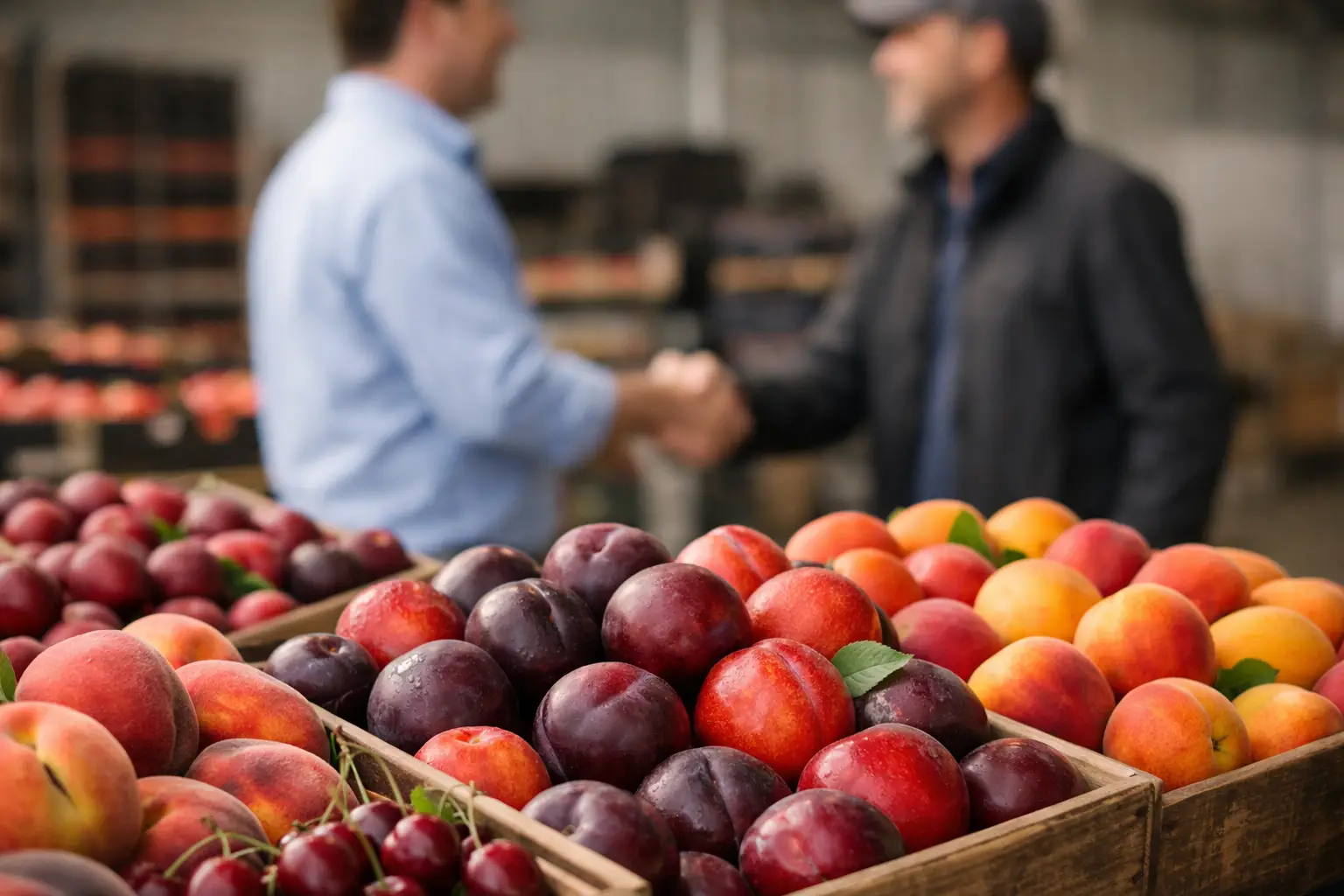
Stone fruit programs rarely fail because of one dramatic mistake. More often, they fail in small, expensive ways - uneven sizing across pallets, fruit packed too early for transit, inconsistent firmness on arrival, or gaps in supply when demand is already committed. That is why choosing a premium stone fruit supplier is not simply a sourcing decision. For importers, distributors, retailers, and wholesale buyers, it is a risk management decision tied directly to margin, shelf performance, and customer confidence.
What defines a premium stone fruit supplier
In wholesale trade, the word premium is used too loosely. A premium stone fruit supplier is not defined by appearance alone, nor by attractive packaging without operational depth behind it. Premium status is built on the ability to deliver fruit that meets market expectations consistently, under real commercial conditions.
For stone fruit, that means much more than color and Brix. It includes varietal selection, harvest timing, sorting discipline, cold chain control, packaging accuracy, and traceability. It also means understanding that cherries, apricots, plums, peaches, and nectarines do not move through the supply chain with the same tolerance. Each product has different pressure points, different shelf-life behavior, and different transit requirements.
A serious supplier works across that complexity with control, not improvisation. That is the difference between a shipment that looks good at loading and a shipment that performs well at destination.
Why wholesale buyers need more than product availability
Availability matters, but availability alone does not create a dependable program. In competitive markets, many suppliers can offer stone fruit during the right window. Far fewer can support long-term planning with predictable execution.
B2B buyers typically evaluate a supplier on three commercial questions. First, can the supplier maintain consistent quality across repeated shipments, not just one good load. Second, can they support specification-based packing with discipline. Third, can they communicate clearly when field conditions shift.
This is where supply chain maturity becomes visible. A supplier with direct access to production and strong field coordination can make better harvest decisions. A supplier with organized quality control can identify issues before loading. A supplier with export experience can align packaging, transit planning, and arrival expectations with the destination market.
Without those capabilities, even good fruit becomes a higher-risk purchase.
The production base matters more than the sales pitch
A polished commercial offer may open a conversation, but the real value sits at the production level. Stone fruit is highly sensitive to timing, weather, maturity stage, and handling. If a supplier is too far removed from the orchard, control weakens quickly.
For professional buyers, this is a practical point. Suppliers with a real production base, combined with partnerships with selected growers, are typically better positioned to protect quality from the start. They can align agronomic decisions with market requirements, monitor orchard performance, and apply stricter harvest criteria.
This matters especially in premium programs. Fruit destined for demanding wholesale and retail channels cannot be treated as a generic commodity. It must be selected with the final market in mind. A retail-ready peach program, for example, may require a different firmness profile and packing approach than fruit intended for immediate wholesale turnover. The same applies to cherries shipped domestically versus export cherries moving through longer transit routes.
A premium supplier understands those differences early, not after the fruit is already packed.
Quality control in stone fruit cannot be superficial
In stone fruit trade, quality control is not a final checkpoint. It is a chain of decisions. Orchard selection, maturity assessment, harvesting practices, sorting, grading, and packing all influence the outcome.
A dependable premium stone fruit supplier puts structure around that process. Uniformity is one of the clearest indicators. Buyers need confidence that the top layer of a box reflects the full contents, that the sizing standard is respected across the lot, and that firmness and external quality remain within agreed tolerances.
This is where strict sorting and standardized packing become commercial advantages, not just operational details. Inconsistent product creates claims, slows downstream handling, and weakens trust with customers who expect repeatable results.
There is also an important trade-off here. Fruit selected for maximum visual maturity may satisfy one market but create pressure on transit life in another. Fruit harvested too early may travel better but underperform in eating quality. Premium supply means balancing these factors according to the route, the customer profile, and the intended sell-through speed.
That balance cannot be standardized blindly. It requires experience and communication.
Traceability and packing discipline reduce commercial risk
For international buyers, traceability is not an extra feature. It is a baseline requirement. When an issue appears, whether related to quality, temperature, or handling, the ability to trace the product back through lot identification and production records is essential.
Strong traceability supports accountability, but it also supports better planning. It allows buyers to work with suppliers that understand the history of each shipment, maintain documentation discipline, and operate according to international standards.
Packing discipline matters just as much. Stone fruit is vulnerable to pressure damage, dehydration, and movement during transport. Packaging must protect the fruit while matching the commercial requirements of the market. The right format depends on the channel. A supermarket chain may require strict presentation and label precision. A wholesale market may prioritize speed of movement and practical handling. An importer managing multiple customer segments may need both.
A premium supplier should be able to adapt packing specifications without compromising product integrity. That flexibility is valuable, but only when it is backed by consistency.
Freshness is not a slogan - it is a logistics outcome
Freshness in stone fruit is achieved through disciplined timing. The period between harvest, packing, cooling, loading, and delivery has direct impact on firmness retention, flavor development, and shelf life.
For that reason, logistics capability is part of product quality. A supplier may offer excellent fruit in the orchard, but if post-harvest handling is weak, the market receives a different result. Professional buyers know this well. They are not buying fruit at harvest. They are buying fruit at arrival.
This is one of the reasons Greek origin continues to attract serious commercial interest in many markets. When managed correctly, Greece offers strong stone fruit potential supported by favorable growing conditions, experienced production regions, and export-oriented supply. But origin alone is never enough. The real differentiator is how effectively the supplier preserves that value through the chain.
At ELYSIAN FRUIT, this approach is built around selected production, strict sorting, professional standardization, traceability, and secure transport designed for demanding wholesale and export programs.
What serious buyers should ask before committing
A useful supplier conversation goes beyond price and weekly availability. Buyers should examine how quality is defined, how lots are controlled, and how exceptions are handled. If a supplier cannot explain their process clearly, that usually signals weak control behind the scenes.
It is worth asking how growers are selected, how maturity is evaluated before harvest, what grading standards are used, how temperature management is maintained, and how mixed quality risks are prevented at packing stage. It is also worth asking how the supplier manages variability during difficult weeks. Every agricultural business faces pressure from weather and seasonality. The difference is how transparently and professionally those pressures are managed.
The strongest partnerships are rarely based on chasing the lowest offer. They are built on reliable execution that protects business continuity over time.
Long-term value comes from consistency, not one exceptional load
Stone fruit buying can be reactive, especially in fast-moving markets. Yet the most successful wholesale relationships are structured around consistency. A buyer needs to know what standard will arrive, how issues will be communicated, and whether the supplier can support the business as volumes grow or customer demands tighten.
That is where premium supply creates measurable value. It reduces rejections, supports stronger sell-through, protects brand reputation downstream, and allows buyers to commit with greater confidence. It also creates room for real commercial planning instead of constant correction.
Not every program requires the same specification, and not every market defines premium in exactly the same way. Some prioritize appearance and shelf presentation. Others focus on firmness, transit endurance, or specific pack formats. A capable supplier recognizes those differences and builds around them without losing control of the essentials.
For wholesale buyers, that is the real test. A premium stone fruit supplier should make your operation more stable, more predictable, and better positioned in the market. When that standard is met consistently, the relationship stops being transactional and starts becoming strategic.
The right supplier does more than deliver fruit. They protect the value of every shipment before it ever reaches your customer.


Comments