
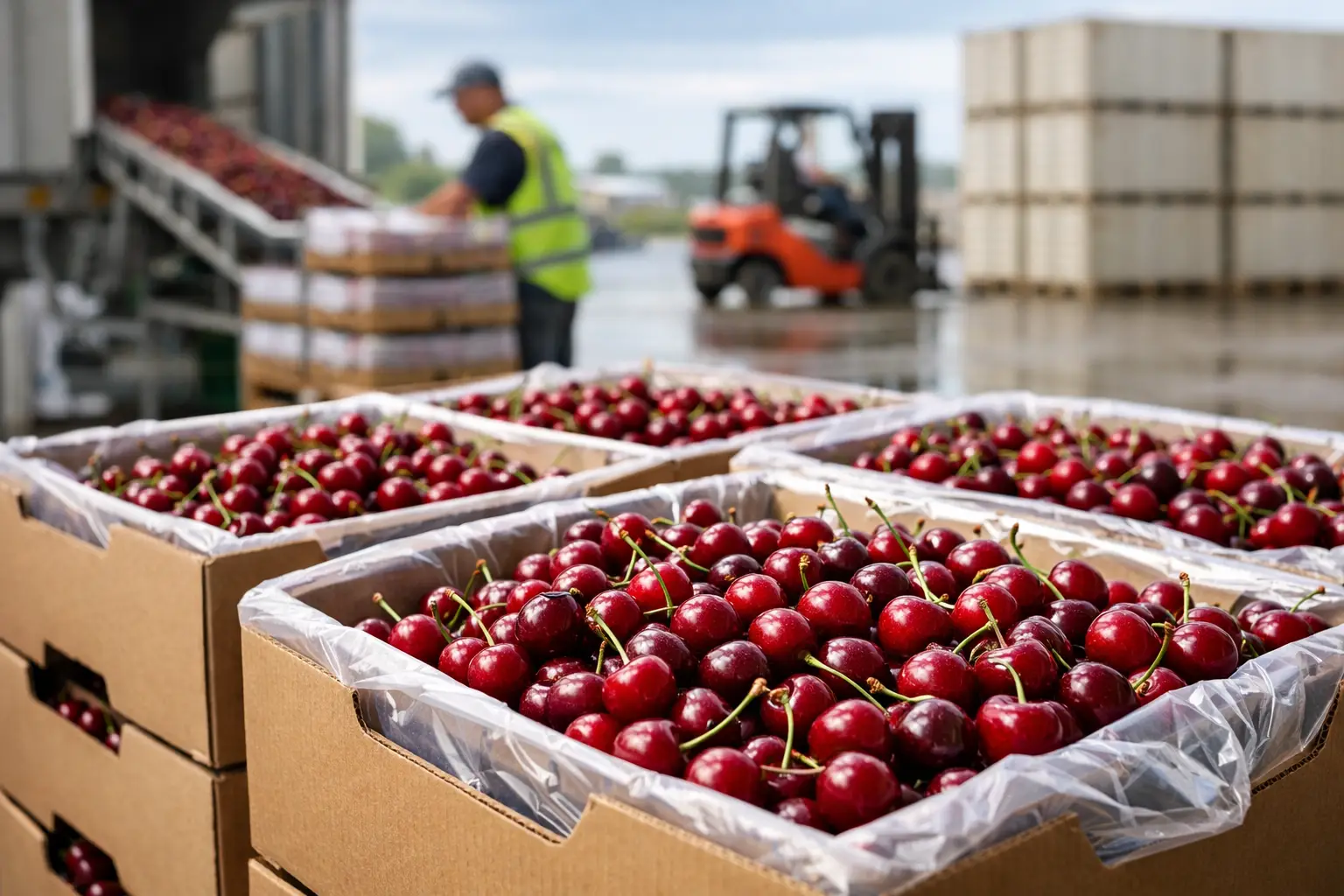
Peak cherry season does not leave room for slow decisions. For importers, distributors, and retail buyers, sourcing bulk cherries for export is a race against time, temperature, and inconsistency. The difference between a profitable shipment and a disputed one often comes down to how the fruit was selected, handled, packed, and moved before it ever reached the destination market.
This is why cherries are not a commodity purchase in the usual sense. They are a high-value, short-window product that requires precision across the full supply chain. Buyers are not simply looking for volume. They are looking for dependable lots, uniform appearance, strong firmness, clean packing, and a supplier that understands export pressure from orchard to delivery.
What buyers really expect from bulk cherries for export
In export trade, cherries are judged quickly and rigorously. Size matters, but size alone is never enough. A strong shipment must also show uniform color, healthy stems, low defect rates, and firmness that can withstand transport and shelf exposure. When buyers commit to bulk cherries for export, they are buying market performance, not just fruit at origin.
That expectation is especially high in premium channels. Supermarket programs, wholesale markets, and established importers need product that arrives with consistency across the pallet, not just in a sample carton. If the top layer looks excellent but the internal lot is mixed, confidence is lost immediately. In this category, credibility is built on repeatable execution.
There is also the issue of timing. Cherries move in a compressed seasonal window, and promotions are often planned around exact delivery slots. A one-day delay can affect pricing, retail placement, or onward distribution. That is why serious buyers evaluate suppliers not only on fruit quality, but on packing discipline, cold chain management, and shipment readiness.
Why origin and grower selection shape export results
Cherry quality starts long before harvest. Orchard location, variety choice, microclimate, and growing practices all influence firmness, sugar balance, skin condition, and shelf life. For export programs, the strongest suppliers are those with real control over sourcing, either through their own production base or through close collaboration with selected growers.
This matters because cherries are highly sensitive to uneven maturity. A lot that includes fruit harvested too early may lack flavor and finish poorly. A lot picked too late may show softness, stem dehydration, or reduced travel tolerance. Good export fruit requires disciplined harvest timing and clear selection criteria at origin.
Greek cherries have a strong position in international trade because they combine attractive appearance with desirable eating quality, especially when grown in suitable regions and handled with care. Still, origin alone is not a guarantee. Professional buyers know that the difference lies in field selection, harvest standards, and post-harvest management. Premium quality is built through decisions, not claims.
Sorting and standardization are where value is protected
A shipment of cherries can only be as strong as its grading process. This is one of the most underestimated points in export buying. When fruit is packed in bulk formats, the risk of inconsistency becomes more expensive. If sizes vary widely or defect tolerance is loose, the buyer inherits operational and commercial problems on arrival.
Strict sorting protects the commercial value of the lot. Uniform caliber, color consistency, and removal of damaged or weak fruit are not cosmetic details. They determine how the product presents at wholesale level, how quickly it can be redistributed, and whether it meets the expectations of retail or foodservice clients.
Standardization also supports planning. Importers prefer suppliers who can define specifications clearly and deliver to them repeatedly. That includes size range, packaging format, labeling, pallet configuration, and inspection discipline. When those elements are controlled, procurement becomes more predictable and disputes are reduced.
For a company such as ELYSIAN FRUIT, the export proposition is strongest when quality control is treated as a commercial responsibility, not a final checkpoint. The market rewards suppliers who understand that every grading decision affects claim risk, shelf life, and long-term account trust.
Cold chain discipline is not optional
If one factor determines the success of bulk cherries for export after harvest, it is temperature control. Cherries lose value quickly when cooling is delayed or inconsistent. Firmness declines, stems dry out, and visual freshness suffers. Once that deterioration begins, packaging alone cannot correct it.
Professional export programs rely on rapid post-harvest cooling, stable storage conditions, and careful loading procedures. The objective is simple: preserve freshness from packing facility to final destination with as little temperature variation as possible. Buyers who handle premium fruit know that cold chain discipline is often the clearest sign of an organized supplier.
This is also where trade-offs appear. Faster shipment options generally protect quality better, but logistics costs may be higher. More economical transport can work, but only if the fruit has been harvested correctly, cooled promptly, packed properly, and scheduled with precision. There is no one-size-fits-all solution. The right export model depends on destination, transit time, customer channel, and target price point.
Packaging for export is a commercial decision
Packaging is often discussed as a technical matter, but in reality it is a sales and risk management decision. The right format protects the fruit, supports ventilation, fits the buyer's handling system, and aligns with the destination market's expectations.
For bulk cherry shipments, packaging must balance protection with operational efficiency. Overpacked fruit can suffer pressure damage. Weak packaging can compromise presentation and increase losses in transit. Poor pallet stability creates avoidable risk throughout the chain. These are not minor details when product is moving through multiple handling points.
Export-ready packaging should also support traceability and clarity. Lot identification, origin information, and labeling consistency help buyers manage inventory and maintain confidence in the supply chain. In demanding markets, documentation and physical presentation work together. A premium product needs both.
Traceability reduces risk for serious buyers
In B2B fruit trade, traceability is part of the value proposition. Buyers need to know where the fruit came from, how it was packed, and how each lot can be identified if questions arise. This is not only about compliance. It is about reducing exposure.
When a supplier offers full traceability, the buyer gains more than paperwork. They gain accountability. That is critical in international trade, where quality claims, inspection findings, and customer feedback can have financial consequences. Clear lot tracking helps resolve issues faster and protects long-term business relationships.
The same applies to food safety and packing standards. Suppliers serving international markets must align their processes with recognized expectations, because buyers cannot afford uncertainty in their upstream chain. Reliable exporters understand that trust is built through systems, records, and consistency over time.
What makes a cherry export partner reliable
The most valuable supplier is not always the one offering the lowest price. In premium fruit categories, reliability has direct commercial value. A partner who delivers agreed specs, communicates early, and handles the season with discipline can save a buyer far more than a small opening price difference.
Reliability shows up in several ways. It shows up in accurate pre-shipment communication, realistic volume commitments, disciplined quality control, and secure transportation planning. It also shows up in honesty. If a lot is suitable for one market but not another, experienced exporters say so early. That kind of clarity helps buyers protect their own customers and margins.
This is especially important with cherries because seasonality can create pressure on both sides. Volumes shift, weather affects harvest timing, and market pricing can move quickly. Strong partnerships are built when both parties understand the product and make decisions based on long-term performance, not short-term opportunism.
Bulk cherries for export require execution at every stage
There is no shortcut in this category. Successful bulk cherries for export depend on disciplined grower selection, precise harvest timing, strict sorting, professional packaging, cold chain control, and dependable logistics. Remove one of those elements, and the entire shipment becomes more vulnerable.
For importers and wholesale buyers, the practical question is not simply whether the fruit looks good at source. The real question is whether the supplier can protect that quality through every step of the chain. That is what separates a shipment that arrives ready for market from one that arrives with excuses.
In a category where freshness, appearance, and timing carry real commercial weight, the right partner brings more than product. They bring structure, accountability, and the confidence to build repeat business around premium Greek fruit.



Comments