
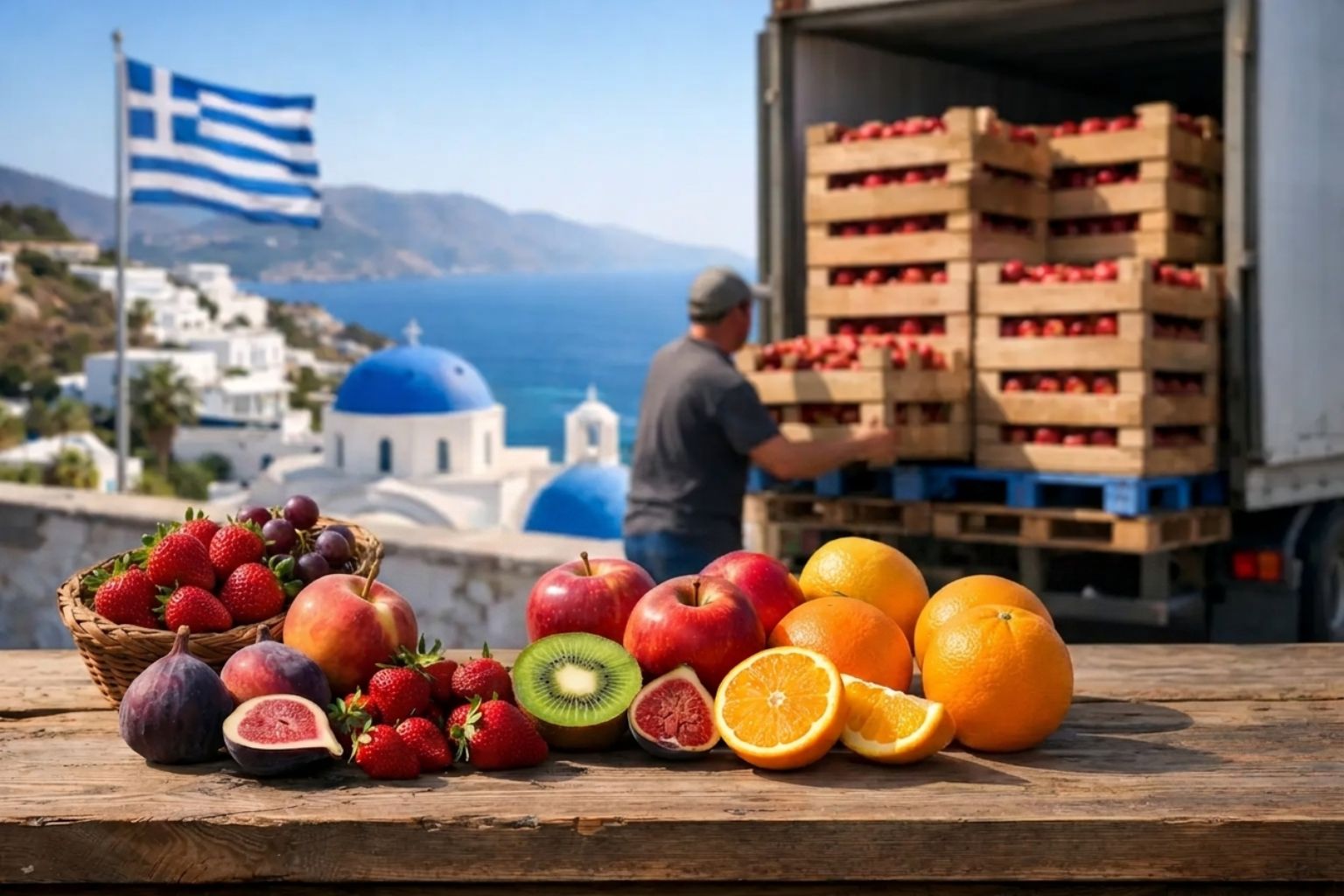
A late shipment in peak season does more than delay a delivery window. It affects shelf life, retail planning, promotions, and buyer confidence across the chain. That is why choosing a greek fruit exporter is not simply a sourcing decision. For importers, distributors, wholesalers, and retail buyers, it is a risk management decision tied directly to quality, continuity, and commercial performance.
Greek fruit holds a strong position in international markets for good reason. The country’s climate, soil diversity, and long agricultural tradition create the conditions for fruit with strong organoleptic characteristics, attractive appearance, and seasonal freshness. But product origin alone is not enough. A professional export partner must convert agricultural potential into consistent, market-ready supply that meets international standards from harvest to final delivery.
What international buyers expect from a greek fruit exporter
For B2B buyers, the discussion starts with product quality, but it never ends there. A reliable exporter must deliver uniformity across batches, clear specifications, dependable packaging, and a logistics process that protects freshness in transit. Premium quality is meaningful only when it is repeatable.
This is where many sourcing relationships are tested. A fruit lot may look excellent at origin, yet still create problems if maturity is inconsistent, sorting is weak, packaging is not adapted to the route, or cold chain discipline is uneven. Professional buyers know that the real value of an exporter lies in execution. The supplier who can maintain standards under commercial pressure becomes a long-term partner, not just a seasonal vendor.
Traceability also carries more weight than ever. In wholesale and retail supply chains, buyers need to know where the fruit comes from, how it was handled, and whether each stage has been managed with discipline. Traceability supports food safety, but it also supports confidence. When an exporter can document origin, batch identity, and handling procedures clearly, the buyer operates with less uncertainty.
Quality begins before packing
The strongest export operations do not begin at the packing line. They begin in the field, with production planning, grower selection, and harvest timing. A serious exporter works either from its own production base or through structured partnerships with selected growers who meet clear quality expectations. That agricultural link matters because quality cannot be corrected later if the raw material is not right.
Fruit intended for export must be selected with the destination market in mind. The right maturity profile for a nearby market may not suit a longer route. A supermarket program may require tighter sizing and stronger visual consistency than a wholesale market order. Premium positioning may call for stricter sorting and more careful presentation, while high-volume channels may prioritize continuity and efficient loading plans. There is no single formula. The exporter must align field decisions with the commercial reality of each order.
This is why disciplined selection is a competitive advantage. Cherries, apricots, plums, nectarines, kiwifruit, chestnuts, persimmons, strawberries, oranges, apples, and peaches each carry different sensitivities in harvest, handling, and transport. The exporter who understands these differences in practical terms is better equipped to protect value throughout the chain.
Sorting, standardization, and the value of uniformity
In professional fruit trading, uniformity is not a detail. It is part of the product itself. Buyers need confidence that a shipment will match the agreed specification not only in one pallet, but across the full load. Size consistency, color profile, firmness, cleanliness, and presentation affect the product’s downstream performance and the buyer’s margin.
Standardization according to international requirements reduces friction. It makes receiving easier, shelf planning more accurate, and claims less likely. It also protects the buyer’s reputation with their own customers. In this sense, sorting and packing are not back-office functions. They are commercial tools.
A premium greek fruit exporter should therefore treat grading and packing as a controlled process, not an administrative step. That means clear quality criteria, trained personnel, careful handling, and packaging choices that support both protection and presentation. Overpacking can increase cost unnecessarily, while underprotecting fruit can lead to loss during transit. The right balance depends on fruit type, route length, temperature demands, and customer format.
Freshness is a logistics discipline
Freshness is often presented as a natural quality of fruit. In export trade, it is also the result of operational discipline. Harvest timing, pre-cooling, packing speed, storage conditions, loading coordination, and transport management all influence the final condition of the product on arrival.
This is one of the clearest distinctions between a trader and an organized exporter. A trader may secure product. An organized exporter manages condition. That difference matters especially in sensitive categories such as strawberries, cherries, apricots, and stone fruit, where even small delays can shorten the sales window significantly.
For buyers serving demanding retail or wholesale channels, safe transport is not negotiable. Packaging integrity, temperature consistency, and shipment planning all affect shrink, shelf life, and customer satisfaction. A partner with established export processes helps reduce avoidable losses. That does not eliminate all supply chain variables, because fresh produce always involves some degree of seasonality and operational exposure, but it substantially lowers commercial risk.
Why Greek origin still matters in competitive markets
Price pressure is constant in international fruit trade, and buyers rightly compare offers across multiple origins. Still, Greek origin continues to hold strategic value when paired with disciplined execution. Greece offers a broad fruit calendar, recognized growing regions, and products with strong market appeal in both traditional and premium channels.
Yet origin alone should never be the sales argument. The stronger case is origin plus control. Greek fruit becomes more competitive when the exporter can back it with dependable quality control, professional standardization, and export readiness. That combination gives buyers something more valuable than a low opening price. It gives them predictability.
In practical terms, predictability supports better planning for importers and distributors. It helps retailers maintain category standards. It enables wholesalers to trade with confidence. In high-turnover markets, the supplier who consistently delivers according to specification often becomes more profitable than the supplier who only looks attractive on the first quote.
How a reliable greek fruit exporter builds long-term partnerships
Long-term B2B cooperation in fresh produce is built on performance under real market conditions. Buyers remember how a supplier responds when volumes tighten, when weather affects sizing, or when a customer requirement changes late in the process. Reliability is measured not only in ideal weeks, but in difficult ones.
That is why communication matters alongside product quality. Professional buyers need realistic availability, clear specifications, prompt updates, and honest handling of any issue that may affect the order. Overpromising creates more damage than a disciplined, transparent approach. An exporter that communicates early and clearly allows the buyer to make informed commercial decisions.
The best partnerships are usually based on shared standards. The exporter understands the buyer’s market position, packaging needs, timing pressures, and quality thresholds. The buyer understands the realities of seasonality, harvest conditions, and product behavior. When both sides operate with precision, the relationship moves from transactional buying toward stable, long-term cooperation.
This is the level at which companies such as ELYSIAN FRUIT position their value. Not simply as suppliers of fresh Greek fruit, but as organized export partners with attention to selected production, strict sorting, traceability, freshness, and safe delivery across international markets.
What buyers should assess before selecting an exporter
A serious buyer will look beyond the product list. The more useful questions concern process. How controlled is the sourcing base? How strict is batch selection? How are specifications maintained across loads? What packaging formats are available? How is traceability documented? How is freshness protected from harvest through loading and transit?
It also helps to assess whether the exporter is structured for the buyer’s channel. Retail supply, wholesale distribution, foodservice, and re-export operations each have different operational needs. An exporter may be strong in one area and less suitable in another. That does not make the supplier weak. It simply means fit matters.
The most valuable exporter is rarely the one making the broadest claims. It is the one with a clear process, measurable standards, and the discipline to execute consistently. In fresh fruit exports, that is what protects quality, supports continuity, and creates the basis for long-term business.
For professional buyers, the right partner is the exporter who respects both the product and the pressure of the market. When premium Greek fruit is backed by selection, control, traceability, and dependable delivery, it arrives not just as produce, but as a credible commercial promise kept.



Comments