
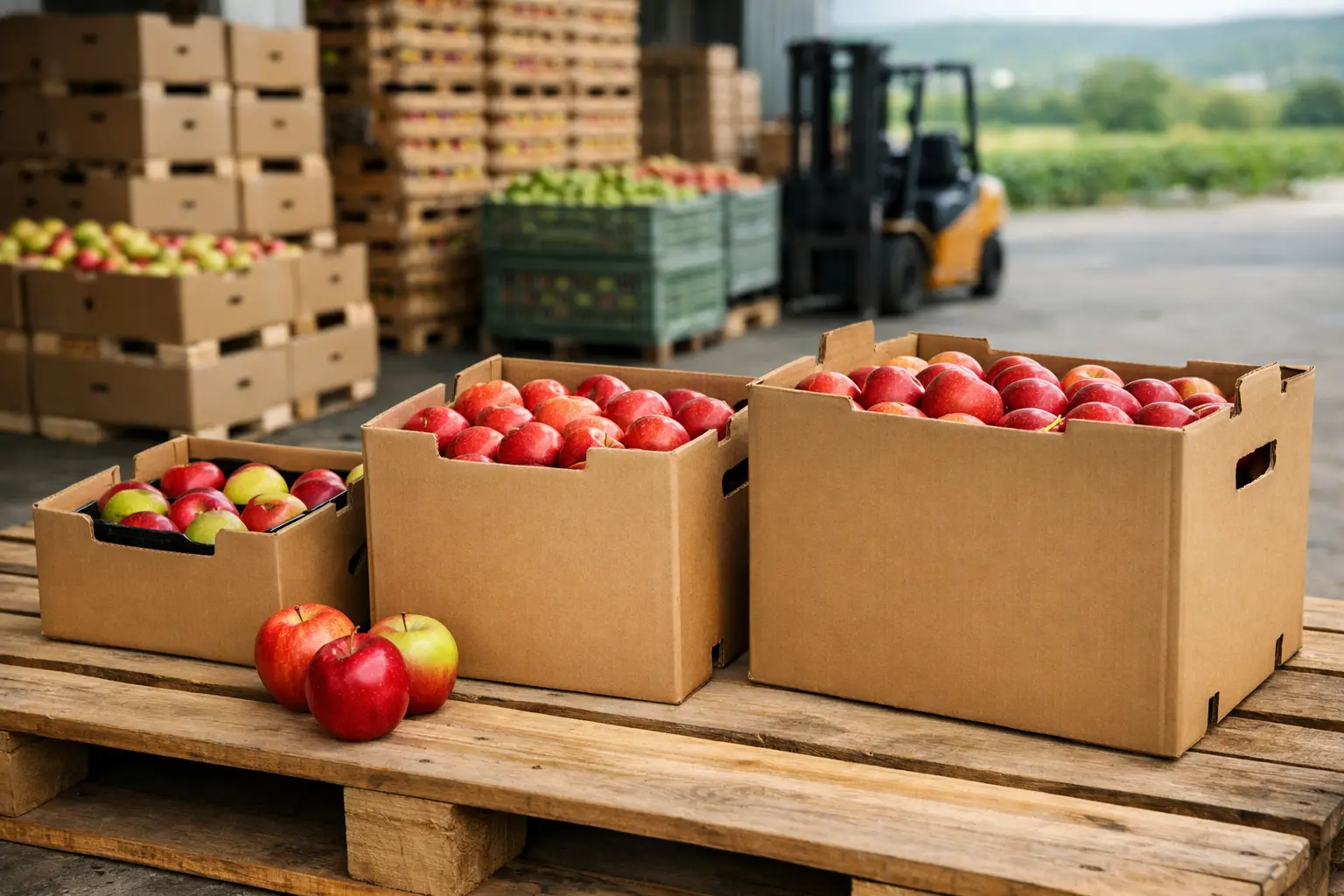
A shipment can be commercially right and still fail at arrival if the carton format is wrong. In apple exports, carton selection affects far more than presentation. It shapes pallet stability, fruit protection, transit cost, retail handling, and the consistency buyers expect across every lot. That is why apple export carton sizes are not a minor packaging detail, but a core part of a reliable export program.
For importers, wholesalers, and retail buyers, the right carton size supports a cleaner supply chain. It reduces compression risk, improves ventilation, helps preserve firmness and finish, and makes receiving and inventory handling more efficient. It also helps maintain the premium quality position of the product from packing line to destination market.
Why apple export carton sizes matter in export performance
Apples travel well compared with softer fruit, but they are not immune to pressure damage, dehydration, or cosmetic loss during long-distance transport. Carton dimensions and pack style directly affect how the fruit behaves under stacking load and refrigerated transit conditions. A carton that is too deep can increase pressure on the bottom layer. A carton that is too shallow may limit the count options needed by a buyer. A carton with poor structural strength can create pallet movement, corner collapse, or ventilation issues inside the container.
For B2B buyers, the carton also has a commercial role. It must match the sales channel. Wholesale markets often prefer practical, familiar formats that move quickly and are easy to repack or resell. Retail programs may require tighter count consistency, cleaner presentation, and dimensions aligned with shelf-ready handling. Foodservice and distribution channels may prioritize net weight and pallet optimization over appearance.
This is why carton size should be discussed at the same time as fruit size range, count, target market, and transit route. Packaging works best when it is specified as part of the full export plan, not as a last-minute packing decision.
The most common apple export carton sizes
There is no single universal carton for apples, because requirements vary by market and pack style. Even so, several formats are widely used in international trade. The most common approach is the telescopic carton or full carton in the 18 kg to 20 kg gross range, often packed as approximately 18 kg net, depending on market specification and packaging materials.
Another standard format is the 13 kg to 14 kg carton, used in markets that want easier manual handling or a count-based retail-oriented presentation. Smaller formats can suit specific supermarket programs or premium lines where uniformity and visual quality are central to the offer.
Tray-packed apples are often packed in cartons designed around fruit count. In these cases, the carton dimensions must work with the tray pattern and the diameter of the fruit. Loose-packed cartons, by contrast, are more flexible on count but still require careful sizing to limit movement during transport.
The practical point is simple: when buyers ask about apple export carton sizes, they are usually asking about more than outer dimensions. They are asking how the carton interacts with fruit count, net weight, stacking performance, and final market handling.
Weight-based vs count-based packing
Weight-based cartons are common in wholesale channels because they are straightforward for pricing and logistics. A buyer knows the net packed weight, and the shipper can build a program around a stable pallet calculation. These cartons are efficient, but they still need size uniformity inside the box to avoid bruising and poor presentation.
Count-based cartons are often preferred when presentation matters more, or when the buyer needs predictable units per box for downstream resale. This format is common for premium apples packed in trays. It supports better uniformity, but the trade-off is less flexibility when fruit sizing changes across the season.
Carton depth and fruit protection
Depth is often underestimated. Apples packed in an overly deep carton may carry unnecessary top load on the lower layer, especially during long container journeys. A shallower carton with the right internal fit can improve pressure distribution and reduce movement. That said, the ideal depth depends on whether the fruit is tray-packed, cell-packed, or loose-packed.
How to choose the right apple export carton sizes
The correct choice starts with the market destination. A wholesale buyer serving open markets may want a proven standard carton that supports price competitiveness and fast turnover. A supermarket importer may require exact dimensions for pallet configuration, retail handling, and distribution center efficiency. The same variety can be packed differently depending on the channel.
Fruit caliber is the next factor. Larger apples need a carton that allows secure placement without pressure points. Smaller sizes may allow a higher count or a different tray arrangement. If the carton format does not fit the actual fruit size profile, the result is usually one of two problems: wasted space or excess pressure. Neither supports premium quality.
Transit time also matters. On shorter routes, a buyer may accept a broader range of practical formats. On longer sea freight programs, structural integrity and ventilation become more critical. Cartons must maintain form under cold chain conditions and stacking load for the entire trip, not just during dispatch.
Pallet efficiency should also be part of the decision. A carton that protects fruit well but leaves unused pallet space can increase freight cost per kilogram. On the other hand, a pallet-maximizing carton that weakens airflow or creates handling stress can damage the commercial result. Good export packaging balances both.
Carton sizes, palletization, and container efficiency
Professional buyers do not evaluate cartons in isolation. They assess how each carton performs on the pallet and in the container. This is where small dimensional differences can create major logistical consequences.
A well-designed apple carton should stack cleanly, resist compression, and fit a stable pallet pattern with minimal overhang. Overhang may look minor at loading, but during long-distance transport it can contribute to crushed corners, unstable wrapping, and inconsistent airflow. A poor pallet footprint can also lead to dead space in the container, which reduces freight efficiency.
Ventilation is another operational concern. Apples need cold chain consistency, and carton design influences how air moves around the load. If the carton size or stacking pattern restricts airflow, the cooling profile across the shipment may become uneven. That can affect firmness, appearance, and shelf life on arrival.
This is why experienced exporters align carton dimensions with pallet standards and route conditions. The goal is not simply to fill space. The goal is to deliver fruit in saleable condition with predictable handling at destination.
Retail-ready needs vs wholesale practicality
The best carton for a supermarket program is not always the best carton for a wholesale market. Retail buyers often expect cleaner graphics, more uniform counts, easier case handling, and dimensions compatible with shelf-ready or backroom processes. They may also request reinforced packaging or stricter count tolerances.
Wholesale channels usually prioritize turnover, durability, and value. They may accept simpler carton construction if it protects the fruit and performs well in logistics. In these programs, standardization is often more valuable than cosmetic packaging upgrades.
Neither approach is better in absolute terms. It depends on the buyer model, the sales environment, and the market price position. What matters is that the carton format supports the commercial objective without compromising quality.
Common mistakes when specifying apple export carton sizes
One common mistake is choosing a carton by habit rather than by shipment profile. A format that worked for one market, season, or variety may not be the right fit for another. Another is focusing only on net weight while ignoring tray compatibility, fruit pressure, or pallet pattern.
A third mistake is underestimating the value of consistency. Buyers do not just want acceptable cartons. They want repeatable specifications across shipments. Consistency supports planning, receiving, inventory control, and confidence in the supplier relationship.
For exporters with a serious international position, packaging should reflect the same discipline applied to sourcing, grading, and cold chain management. At ELYSIAN FRUIT, that approach is part of how premium Greek fruit is prepared for demanding B2B markets - with attention to traceability, standardized packing, and safe transport conditions that support long-term trade relationships.
What buyers should confirm before booking
Before finalizing a program, buyers should confirm the carton type, net weight, expected fruit count, internal packing style, pallet pattern, and loading plan. They should also verify whether the carton specification has been matched to the intended route and customer channel. These details reduce avoidable claims and help align expectations before the fruit leaves origin.
Good export business is built on details that hold under pressure. Apple carton selection is one of those details. The right format protects product value, supports efficient logistics, and gives buyers one less variable to worry about when the shipment reaches market. In premium fruit trade, that kind of reliability is never secondary.







Comments