
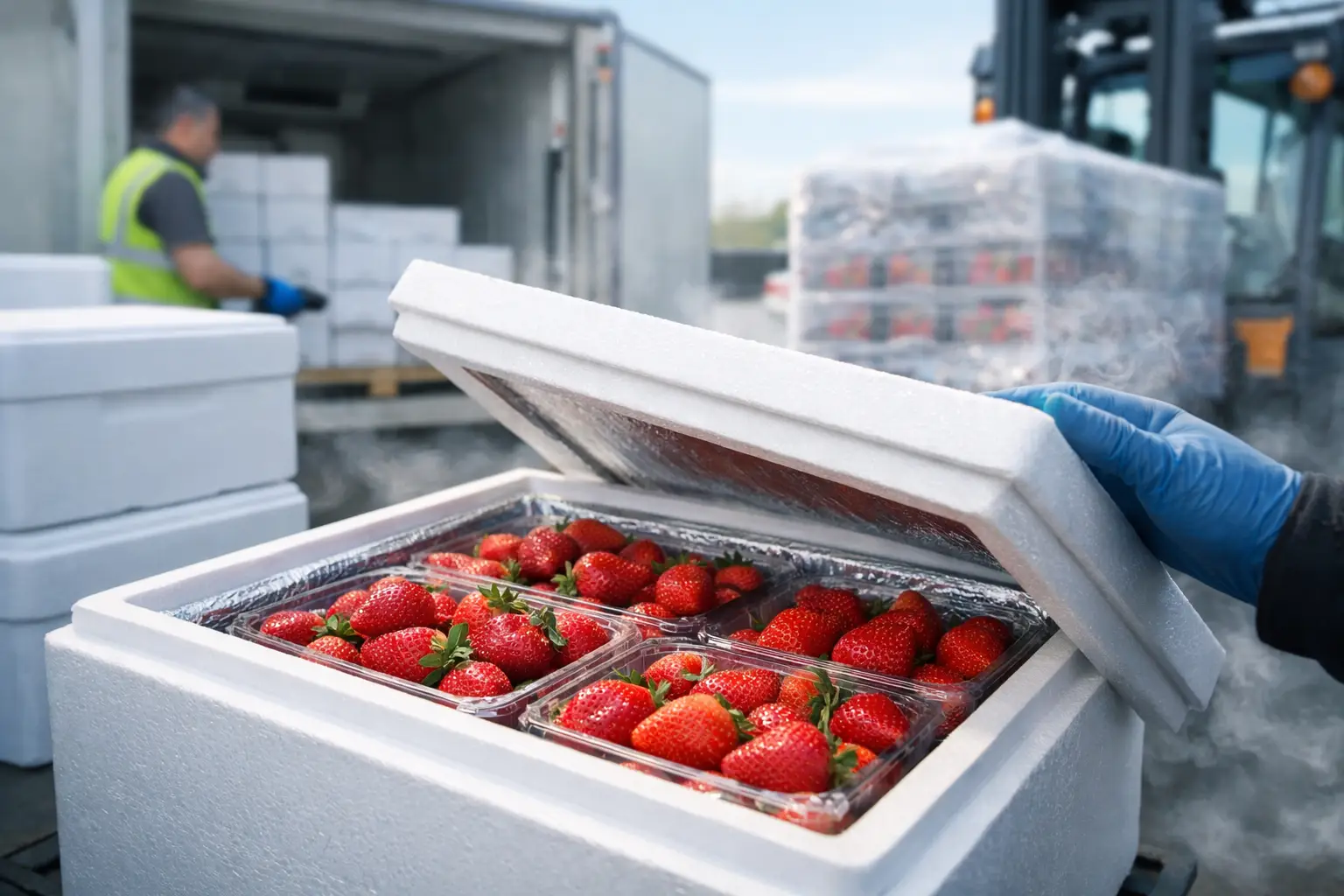
A strawberry can lose commercial value in a matter of hours, not days. For importers, wholesalers, and retail buyers, that makes strawberry cold chain shipping less of a logistics detail and more of a quality decision with direct margin impact.
Strawberries are among the most temperature-sensitive fruits in the fresh produce trade. They respire quickly, dehydrate easily, bruise under pressure, and deteriorate fast when field heat is not removed on time. Even a visually strong lot at packing can arrive with softness, leakage, color loss, or shortened shelf life if the cold chain is inconsistent for only part of the journey. In practice, every stage matters - harvest timing, pre-cooling, packaging design, pallet build, truck loading, transit control, and final delivery discipline.
Why strawberry cold chain shipping is so demanding
Strawberries do not offer much tolerance for delay. Their skin is delicate, their water content is high, and their post-harvest life is limited compared with many other fruits. That means the shipping process cannot compensate for weak fruit selection or slow temperature management. It can only protect quality that was already secured in the field and at the packing line.
For B2B buyers, the commercial risk is clear. When strawberries arrive with uneven firmness or condensation damage, the issue is not limited to waste. It affects shelf presentation, sell-through speed, shrink, customer complaints, and confidence in the supplier. In export markets, where delivery windows are tighter and claims can be more complex, poor temperature discipline can quickly become a reputational problem.
This is why serious strawberry programs are built around control, not assumptions. Premium quality is preserved through measured handling, documented procedures, and traceability from origin to destination.
The first critical window is harvest and pre-cooling
A stable cold chain starts before the fruit leaves the farm. Strawberries harvested during the wrong temperature window carry more field heat and lose firmness faster. If picking is delayed into warmer hours, cooling takes longer and the fruit begins the shipping cycle under greater stress.
Pre-cooling is the first major quality checkpoint. The objective is simple: remove field heat as quickly as possible and bring the fruit to the target range without delay. When this step is slow or inconsistent, the shipment may still look acceptable at dispatch, but shelf life has already been reduced. That hidden loss often appears later, at destination.
For professional buyers, this is an important distinction. Fruit quality is not judged only by how the load looks when doors open. It is judged by how it performs through distribution, display, and final sale. Effective pre-cooling supports that performance.
Packaging is part of the temperature strategy
In strawberry cold chain shipping, packaging is not only about presentation. It directly affects airflow, moisture management, fruit protection, and load stability. A package that looks attractive but restricts cooling efficiency can create uneven temperatures within the same pallet. That leads to variable quality across the shipment.
Good packaging balances ventilation with protection. It must allow cold air circulation while reducing pressure damage and limiting movement during transport. The right format also depends on market requirements. A wholesale program may prioritize stack strength and operational efficiency, while a retail-ready program may give more weight to presentation and shelf handling.
There is always a trade-off to manage. More ventilation can improve cooling, but weak structural integrity can increase handling damage. Tighter packing may improve pallet efficiency, but excessive compression can bruise fruit. The right choice depends on route length, customer specification, and expected turnover speed at destination.
Temperature consistency matters more than average temperature
One of the most common misunderstandings in perishables logistics is the idea that an acceptable average temperature is enough. With strawberries, that is not the standard. A shipment can show a reasonable average and still suffer from damaging fluctuations at loading, during border delays, at cross-dock points, or while waiting for unloading.
Temperature breaks are costly because strawberries respond quickly. Warm exposure accelerates respiration and moisture loss. If the fruit is re-cooled afterward, that does not fully reverse the damage. It only slows further deterioration.
That is why disciplined loading practices matter. Product should move into a pre-conditioned vehicle without unnecessary waiting on the dock. Pallets should be built to support airflow. Reefer settings must match the product requirement, but settings alone are not enough if loading patterns block circulation or if warm product enters the trailer.
For international buyers, data visibility is increasingly valuable here. Temperature monitoring and shipment documentation do more than support claims management. They create confidence that quality control has been handled professionally and according to international standards.
Transit planning is part of quality control
A strawberry shipment is only as reliable as the plan behind it. Route choice, transit duration, border conditions, delivery scheduling, and contingency preparation all influence arrival quality. The fruit may be excellent, but if the logistics plan adds avoidable hours or uncertainty, the commercial result can still fall short.
In short-haul regional movements, the focus may be on fast turnaround and dock discipline. In longer export programs, planning becomes more demanding. The buyer needs consistency not only in fruit quality, but also in arrival timing, pallet condition, labeling accuracy, and document readiness.
This is where organized exporters stand apart. They do not treat transport as a final handoff. They manage it as part of the product itself. That includes aligning harvest with dispatch schedules, building loads for route conditions, and maintaining traceability throughout the movement.
Quality control must continue after packing
Many problems in strawberry shipments begin with the assumption that packing is the final quality gate. In reality, quality control should continue through staging, loading, dispatch, and delivery confirmation.
A strong program checks for uniformity, firmness, color, cleanliness, packaging integrity, labeling, and temperature condition before shipment release. It also verifies that pallets are stable and that product identity is preserved lot by lot. For B2B customers, this level of control is not optional. It protects traceability, reduces dispute risk, and supports long-term supply relationships.
When a supplier manages quality this way, the benefit is practical. Buyers receive fruit that is more predictable in distribution. That predictability matters in wholesale and retail environments where labor, shelf space, and promotional timing are planned in advance.
Traceability strengthens trust in strawberry cold chain shipping
For professional markets, traceability is no longer just a compliance matter. It is a business advantage. In strawberry cold chain shipping, traceability connects production origin, packing date, lot identification, quality checks, and transport conditions into one accountable system.
If an issue appears, traceability helps isolate it quickly. More importantly, when no issue appears, it reinforces trust. Buyers want to know not only that fruit arrived well, but that the process behind it is repeatable. A repeatable system lowers risk and supports long-term procurement decisions.
This is especially relevant for premium fruit programs where consistency is as important as appearance. Reliable partners are evaluated on more than one shipment. They are judged on whether they can deliver the same standard over time, across volumes, and under changing market pressure.
What serious buyers should expect from a supplier
For strawberries, a credible supplier should be able to demonstrate control across the full chain - selected production, disciplined harvest timing, rapid pre-cooling, careful packing, temperature-managed transport, and clear traceability. If one of these elements is weak, the rest of the chain carries more pressure.
Buyers should also expect transparency about limitations. Not every route, packaging format, or delivery window offers the same result. A professional supplier does not promise identical performance for every market condition. Instead, they align product, packaging, and logistics with the real demands of the program.
That is the difference between selling fruit and managing a fresh produce supply chain. One is transactional. The other protects value.
At ELYSIAN FRUIT, this approach reflects the standard expected in premium export trade: selected fruit, strict sorting, packaging aligned with international requirements, and controlled movement from origin to final delivery. For buyers who need consistency, that level of organization is what turns freshness into a dependable commercial outcome.
In strawberries, quality is never secured by speed alone or by refrigeration alone. It is secured when every handoff respects the fruit, the specification, and the buyer’s market reality. That discipline is what keeps a premium shipment premium when it arrives.






Comments